




Underground salt kingdom Europe’s strangest tourist attraction
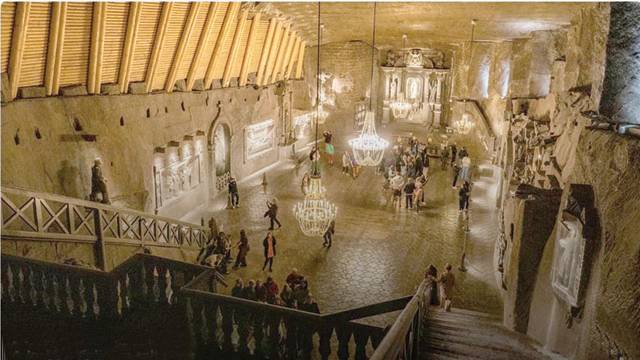
WIELICZKA, POLAND – Down at the bottom of 380 dizzying steps, the walls are an imperfect gray. They look like rock, but they taste salty. How do visitors know? They’re encouraged to lick them. Just to the southeast of Krakow, Poland’s second-largest city, lies the underground realm of the Wieliczka Salt Mine, part cathedral, part industrial relic, part theme park. Every day, up to 9,000 visitors descend into the mine, which was declared a UNESCO World Heritage Site in 1978. Salt production at Wieliczka ended in 1996. But after 700 years of operation, and more than 150 miles of tunnels chiseled underground, it lives on as a tourist attraction. Over the centuries, miners at Wieliczka created nine levels of tunnels and chambers reaching 1,073 feet, nearly 330 meters below the surface. Today, around 2% of what they created remains open to the public. Even that fraction is impressive. Accompanied by guides, visitors can walk the classic tourist route just over two miles in about two hours or opt for the “miners’ route.” On the three-hour adventure, they’re given a headlamp, helmet and emergency carbon monoxide absorber. The tourist route begins with the descent down those 380 steps or a ride in an elevator. Labyrinthine passageways lead to preserved chambers hollowed out from the rock by hand. Today, they’re filled with statues, carvings and grand chandeliers that trace the mine’s history and offer insight into the lives of those who worked there. The tourist route ends at the third underground level, 450 feet below ground. The miners’ route runs between depths of 187 and 330 feet. The salt walls are not white because the sodium choride is not pure, explains tour guide Patrycja Antoniak, as she exhorts her visitors to lick the surfaces. “Not there,” she warns, cueing up a big “ewwww!” moment. “Many people lick there.” “Ninety to ninety-five percent of the rock is salt, sodium chloride and impurities give the salt the gray colour,” she says. In Wieliczka, the mix includes other minerals as well as sand, silt, and claystone. Despite the colour, it’s still edible, Antoniak adds. “It was used to preserve food without being purified.” Halite, the proper name for rock salt, forms when ancient bodies of water evaporate. Some deposits are hundreds of millions of years old. The one at Wieliczka is relatively young about 13.5 million years old. Tectonic movement in the Carpathian Mountains later pushed the salt layers closer to the surface, making them easier to find. Wieliczka contains both “bedded” or layered deposits and “lump” deposits, where the most ornate chambers are located. Miners chiseled them out inch by inch until 1743, when gunpowder was introduced. Mechanical drills followed about 150 years later. To prevent collapse, miners left a layer of salt in each chamber. Today, the structures are reinforced with modern engineering, including fiberglass rods inserted into the walls. Excavation began in the late 13th century, though salt had long been essential to life here. Prehistoric communities boiled water from briny springs, evaporating it to collect salt that was traded as currency.
As demand grew, wells were dug to access brine, followed by shafts. It was in one of these shafts that the first lumps of rock salt were discovered in the late 1200s. In the 14th century, the mine became a royal asset under King Casimir III of Poland. Known as Casimir the Great, he recognized salt’s economic power. Revenue from extraction accounted for as much as a third of the royal treasury’s income during his reign, wealth that helped finance Poland’s first university. By the end of the 15th century, Wieliczka was producing between 7,000 and 8,000 tons of salt annually.