




Kamil Mumtaz advocates traditional wisdom for a sustainable future
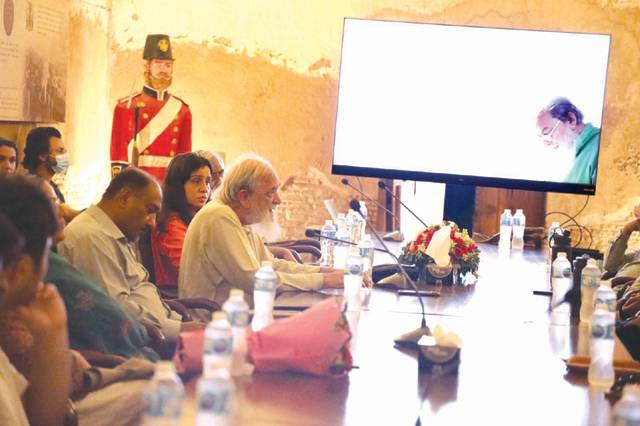
LAHORE – Pioneering architect Kamil Khan Mumtaz, whose work draws on Islamic architecture and traditional building techniques from South Asia, led a session at the Lahore Fort in which he underscored the pressing need for restoration that goes beyond heritage sites. The talk titled the “Café Learning Session”, was held at the Fort’s historic Barood Khana, and organised by Aga Khan Cultural Service – Pakistan (AKCS-P). The event brough together a diverse group of creative professionals working in conservation and architecture, including architects, fine artists, conservation experts, engineers and archivists. Discussions focused on the dangers of unchecked industrialisation,namely climate change and its destructive impacts and traditional economies of earlier centuries being more conducive to sustaining the environment. Tracing the link between humans and the environment, he contended that life requires an interaction with the environment which involves extracting resources from it and giving back to it. This has to be an equal exchange, he argued.“You cannot sustain an unequal balance; in our dealings and exchange with nature there is a measurable and precise limit that cannot be exceeded.” He warned that nature does not possess unlimited resources. “To put it simply, we cannot take more from it than its capacity. The ideal state of an ecosystem is one of perfect balance between ‘give and take’, which is essentially the normative state,” he observed. Giving a new context to term ‘circular economy’, Mumtaz added that 300,000 years ago, the world was governed by a natural economy in which humans only took from nature what they needed and gave back what they didn’t need. This economy he said, sustained life in perfect balance. “In a hunting-gathering society there was no advantage of hunting more. You hunt only as much as you require.” He identified the Agricultural Revolution as the first disruption to this‘circular economy’ of a harmonious way of life. Efforts were made to extract more out of natural resources such as land and animals. This altered the traditional hunting and gathering economy by introducing mechanisms of production that led to the generation of surplus. He noted that following the 1970s, nature’s upper limits had been “crashed,” as consumption began to exceed the planet’s capacity to regenerate its resources. Machines and industrial production enabled ever-increasing output, with machines capable of working continuously without falling ill or dying.There was industrialization of agriculture which brought with it the endless use of presticides which posed risks to human health and tractors that contributed to pollution and greenhouse gas emmissions fuelling climate change. He described this as the “new norm”, which in the broader scheme of things is a relatively recent phenomon given that for 300,000 years we were living in a perfect balance of production and consumption. “We are in the terminal stage in the cycle of time,” he bemoaned describing the phenomenon of climate change which has led to devastating consequences including global warming, the irreversible melting of ice caps, flooding and landslides among others. Mumtaz suggested that philosophical foundations of tradition and modernity are inherently different. In traditional societies, progress is measured by the extent to which one becomes a good human being he propounded, while in modern societies, success is often gauged by the acquisition of material wealth. He critiqued the contemporary discourse on conservation, which, he maintained, echoes a postmodern view of the world that regards heritage sites primarily as material assets. Instead, he said, the deeper philosophy of conservation needs to be understood — one that looks to the wisdom of the past and offers enduring insights for the present. This wisdom is evident in traditional building techniques that were responsive to the climate and created resilient infrastructure. Sharing his thoughts on the talk, CEO AKCS-P Tausif Khawaja said: “Today’s session made a strong case for mainstreaming traditional knowledge and techniques. The value of these approaches is evident in the traditional building practices used in historic structures that are climate-friendly and produce resilient structures. Heritage sites across our country have stood the test of time and remain majestic examples of architectural excellence.”