

Before macarons were pink and pistachio, they were Arab — and here’s how you can make them
Although legend states that the macaron was first introduced to the French Royal Court by the then Queen of France (and Italian noblewoman) Catherine de’ Medici in the 16th century, its origins are most likely 300 years older and not European but Arab.
According to food historians, the macaron, or rather its predecessor, was most likely introduced to the Sicily region by Arab soldiers in the 13th century. The dessert then gained in popularity in Italy before it eventually found its way to France.
In the 18th century in the French town of Nancy, two nuns, Marguerite Gaillot and Marie Morlot, popularised macarons, which they baked and sold to support themselves. The nuns found themselves without a home after a 1792 decree abolished religious congregations, which led to their expulsion from their abbey. The bakery they founded, Maison des Soeurs Macarons (‘House of the Macaron Sisters’), still sells macarons to this day.
But the macaron that we know and love today was created by Parisian pâtissier Pierre Desfontaines in 1930: he reinterpreted the dessert as two macarons sandwiching a filling of jam or ganache. The modern, eye-catching and colourful macarons may be a world away from the original dessert, but they are also a testament to how different ideas and cultures can even shape the humble biscuit.
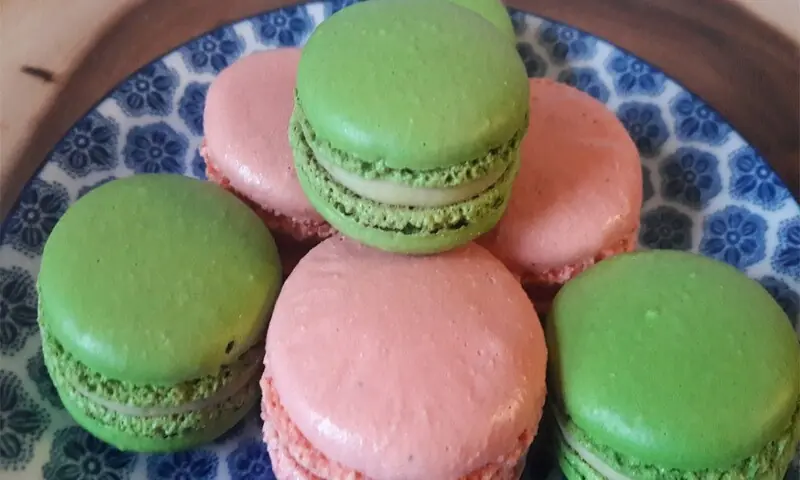
Rose and Pistachio Macarons
There’s something romantic and delicate about macarons — their allure lies in the fact that making them is as much art as science. As every baker will tell you, they have their own way of making macarons and getting them right can take a number of attempts and experimentation. But once mastered, nothing beats the crunchy, decadent macaron.
There are also three different methods to make them: the French, the Italian and the Swiss way. The French one is considered the easiest for beginners and is the one given below.
Ingredients (Makes 40 macarons)
For the macarons
6 egg whites
Vinegar or lemon juice (as needed)
¼ teaspoon cream of tartar
1/3 cup granulated sugar
11/3 cup almond flour (1¼ cup whole almonds ground into flour)
1 cup confectioner’s or powdered sugar
¼ teaspoon rosewater extract (for the rose macarons)
¼ teaspoon almond extract (for the pistachio macarons)
1 drop of red food colouring (optional)
1 drop of green food colouring (optional)
For the pistachio filling
¼ cup softened butter
1½ tablespoon malai (cream)
1 cup confectioner’s sugar
3 tablespoons finely ground pistachios
For the rose filling
¼ cup softened butter
1½ tablespoons malai (cream)
¾ cup confectioner’s sugar
1 teaspoon rose syrup
Method
- Age the egg whites — this stabilises the macaron. Coat a mixing bowl with vinegar or lemon juice. Take out an additional two small bowls. Crack eggs in one bowl, separate the egg whites from the yolks and pour into the second bowl. Make sure there is absolutely no yolk mixed in with the whites. Pour the egg whites into the large bowl. Whisk thoroughly. Cover the bowl in cling film and place in the fridge for 24 hours.
- After a day, take out the egg whites from the fridge. Add the cream of tartar. Stir well.
- Grind the granulated sugar in a blender to make it even finer — the finer the sugar, the better the macarons will turn out.
- Beat the mixture continuously with a whisk or an electric beater until soft peaks form. Add 1/3 of the granulated sugar and whisk vigorously for a minute or so (for five to 10 seconds on medium speed if using the electric beater). Then add 1/3 more of the sugar and whisk again. Add the last batch of sugar and repeat. Continue beating until stiff peaks form.
- Make the almond flour by grinding the almonds in a blender until a fine powder forms.
- In a separate bowl, add the almond flour and powdered sugar. Mix together.
- Fold 1/3 of the egg mixture into the dry ingredients. Repeat two more times. Continue folding the batter until it has the consistency of honey or a thick syrup.
- Split the batter in half. Stir in almond extract in one and rose extract in the other. Fold in the green food colouring in one and the red in the other.
- Line three baking trays with parchment paper. Spoon the macaron batter into a piping bag. Squeeze out two-inch round macaron shells two to three inches apart. Continue doing so until all the mixture has finished.
- Slightly lift the trays and bang them hard to flatten the macaron shells and to remove any air bubbles. You can also use a toothpick to pop out any bubbles.
- Preheat oven to 160 degrees Celsius.
- Air dry the batter for half an hour until the top layer of the macaron has hardened. This prevents the shells from cracking during the bake.
- Bake in batches for 12-15 minutes or until the macaron is set/firm to the touch. Take out of the oven and cool on racks.
- Make the pistachio and rose fillings: mix all the listed ingredients together. Spoon in the filling in separate piping bags.
- Pipe out the pistachio filling on the flat part of the green macaron shell. Add another green macaron shell, with the flat part facing down, on top.
- Pipe out the rose filling on the flat part of the pink macaron. Add a second pink macaron shell, with the flat part facing down, on top.
- Place the macarons in a serving dish and have as is or with coffee or tea.
Originally published in Dawn, EOS, February 15th, 2026