




For the Gujrati in me, winter without Hara Lasun is just cold weather
Winter in Karachi is about to bid us farewell, and with it go the small rituals and seasonal indulgences that only make an appearance once a year. In my family, Hara Lasun (green garlic) sits right at the top of that list.
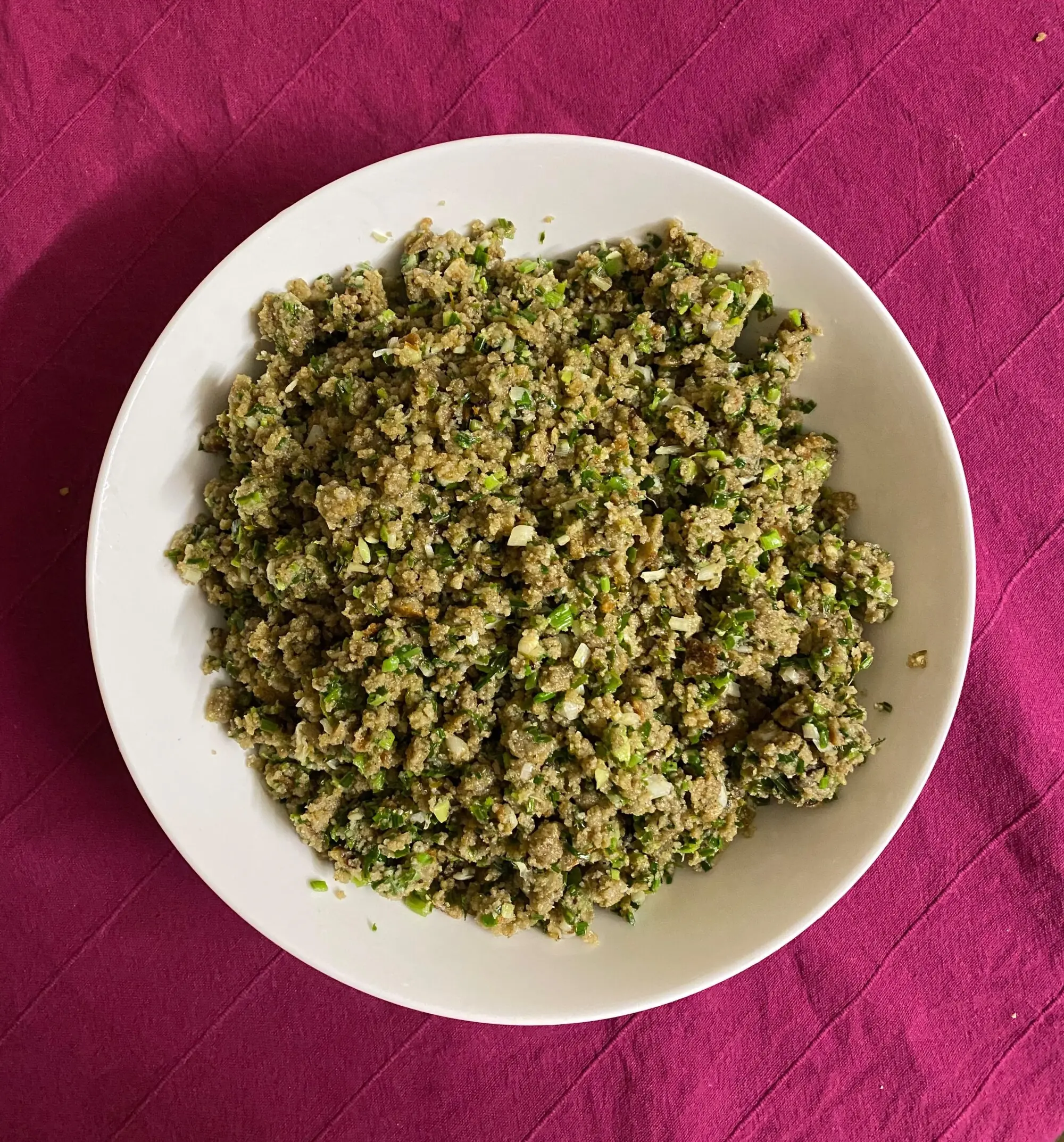
The dish, which goes by the name of its hero ingredient, Hara Lasun, is an earthy, multi-layered savoury breakfast consisting of thinly chopped hara lasun, mixed with crumbled bajra roti, topped with a smoky eggplant dip and a dollop of freshly whipped yoghurt.
Winter smells like hara lasun
Hara lasun — young garlic plant — is a winter ingredient through and through: the green stalks and tender white bulb of young garlic are harvested before the cloves fully develop. It’s milder than dried garlic and gentler on the nose, with a sweetness that adds freshness rather than bite.
Used generously, it perfumes a dish (and the dining area) without overwhelming it.
For me, winter mornings smell like warm, broken pieces of bajray ki roti, slicked with desi ghee or til ka tel (sesame oil), a heap of finely chopped hara lasun, and a bowl of smoked baingan ka bharta. It’s the kind of breakfast we eat slowly, usually at my Nano Ami’s house, or my late phuppo’s, seated around a table that smells faintly of smoke, ghee and green garlic.
Even though the ingredient should technically be spelt hara lehsun, everyone in my family — and most importantly my Nano Ami — insists on calling it “lasun”, not “lehsun”. Trust me, I’ve tried fighting her on this. I’ve presented arguments, pronunciation logic, perhaps even mild theatrics but none of it worked. There comes a point where you simply learn that Nano Ami outranks the dictionary, and you stop arguing.
Where the dish comes from
This dish is largely known today as a Memoni winter staple, particularly in Karachi. But growing up, my Gujarati grandmother always insisted it came from Junagadh, in India’s Gujarat.
When I finally looked into it, the histories overlapped.
According to commonly held accounts, the Memon community traces its roots to the Lohana Hindu community, many of whom embraced Islam centuries before Partition. A section of this community settled in the Kathiawar (also spelt Kathiawad) peninsula in Gujarat, which includes Junagadh — a region historically known for winter vegetables, millet-based breads, and robust, warming foods.
The Dhoraji Youth Services Foundation notes: “It can also be said with authority that the Memons of Kathiawar came from the Hindus of Lohana community… From Vinjhan they migrated to Rojhiwada in Kathiawad and from there to different parts of the world.”
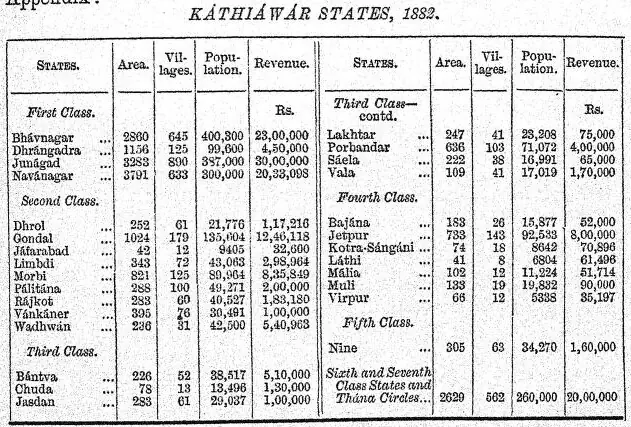
Junagadh itself is listed as a state within the Kathiawar region in the Gazetteer of the Bombay Presidency, Vol VIII. When I asked my Nano, she said without an ounce of hesitation or doubt: “This is a Junagadh dish”. When I argued that it might just be a Memon dish, she responded frustrated, “Haan tou hum sab sath rehtay thay, Memon bhi thay Junagadh main (Yes, so we all lived there together, Memons were also in Junagadh).”
She learnt the dish from the women of her beloved Peshawari Gali in Junagadh, and carried it with her after migrating to Pakistan.
So the dish travelled to our home the way many recipes do — through memory, migration, and women who refused to let flavours be forgotten.
A dish that asks for time
Part of what makes hara lasun special is the effort it demands. This is not an ordinary weekday meal — it’s a communal one.
When my phuppo was alive, winters meant sleepovers. All 13 of my father’s siblings would turn up with their families and once dinner was cleared, the real work began.
Cleaning and chopping hara lasun, with a side of gossip, laughter and masti mazaak (fun).
My phuppo would meticulously wipe each stalk with a clean, damp cloth, starting from the bulb and moving down in one smooth motion to remove all the dust from the root vegetable, aligning neat bundles as she went. I, her self-designated sous chef, was tasked with chopping the lasun as thinly as humanly possible. For a household as full as ours, it took us three to four hours.
That, more than anything, is the dish.
The supporting cast
While the garlic was being prepped, someone, usually my mother, would be on roti duty.
Bajray ki roti (pearl millet bread) is unforgiving. Made from pearl millet flour, it’s gluten-free, hence prone to cracking. However, the women in my house perfected an innovative workaround: two thin sheets of plastic (often cut from shopping bags), dough sandwiched between them, rolled gently. The roti slid cleanly onto the tawa (hot plate) without breaking, much like you slide a frozen paratha onto your tawa.
Once on the hotplate, shallow diagonal slits were cut to help it cook evenly. When both sides were done, it was drenched in ghee (no restraint). We were told it is to moisten the otherwise dry roti.
Then came the baingan ka bharta. Eggplants charred directly over the flame, rotated patiently so nothing burned unevenly. The skin peels away easily once soft. The flesh is mashed, salted, and smoked using a glowing hot coal and a teaspoon of oil trapped under a lid just long enough to perfume the bharta without overpowering it.
And finally, thick, freshly whipped yoghurt. Easy to overlook, but essential. It cools the dish, binds the flavours, and softens what is otherwise rich and intense.
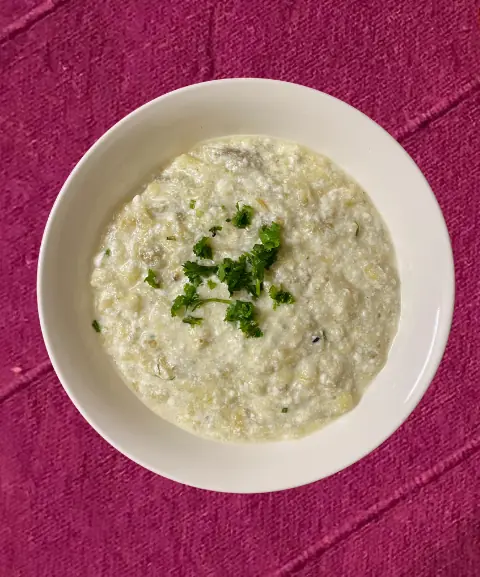
Before serving, the chopped hara lasun and broken bajray ki roti are mixed and loosened with a little sesame oil. Each person builds their own bite: roti, lasun, bharta, yoghurt — in whatever proportion feels right. Some also like to mix the bharta with yoghurt before serving.
Why hara lasun appears only in winter
Green garlic is harvested before the garlic bulb matures, making it strictly seasonal. In South Asia, it appears briefly in winter markets, particularly in regions with millet-based food traditions like Kathiawar and parts of Sindh. Different homes celebrate the crop in different ways — from haray lasun ke laddoo, to haray lasun ki daal, to haray ki sabzi and so many other dishes. Its short season is precisely why dishes built around it remain celebratory rather than everyday.
Recipe (serves 2–3)
Hara lasun mix
- Hara lasun (green garlic): ½ kg
- Sesame oil: a small splash (to moisten)
Bajray ki roti
- Bajray ka atta (pearl millet flour): 500g
- Water: to knead
- Salt: to taste
- Sesame oil: 1 tbsp (for binding)
- Desi ghee: 2–3 tbsp (for finishing)
Baingan ka bharta
- Eggplants: 2
- Salt: to taste
- Coal: a small piece
- Oil: 1 tsp (for smoking)
Yoghurt base
- Thick yoghurt: 500g, whipped smooth
Just because I wouldn’t want my readers to curse me for the heaviness that takes over after you have a bowl of that lasun and roti mix, I will leave you with a pro-tip: finish off the meal with a fresh orange to help with the food coma. Citrus, another winter special, does a great job at cutting the density of the dish.
It was also the only male contribution towards the dish at our home — ensuring a good supply of fresh oranges from our local vendor to finish off the winter feast.
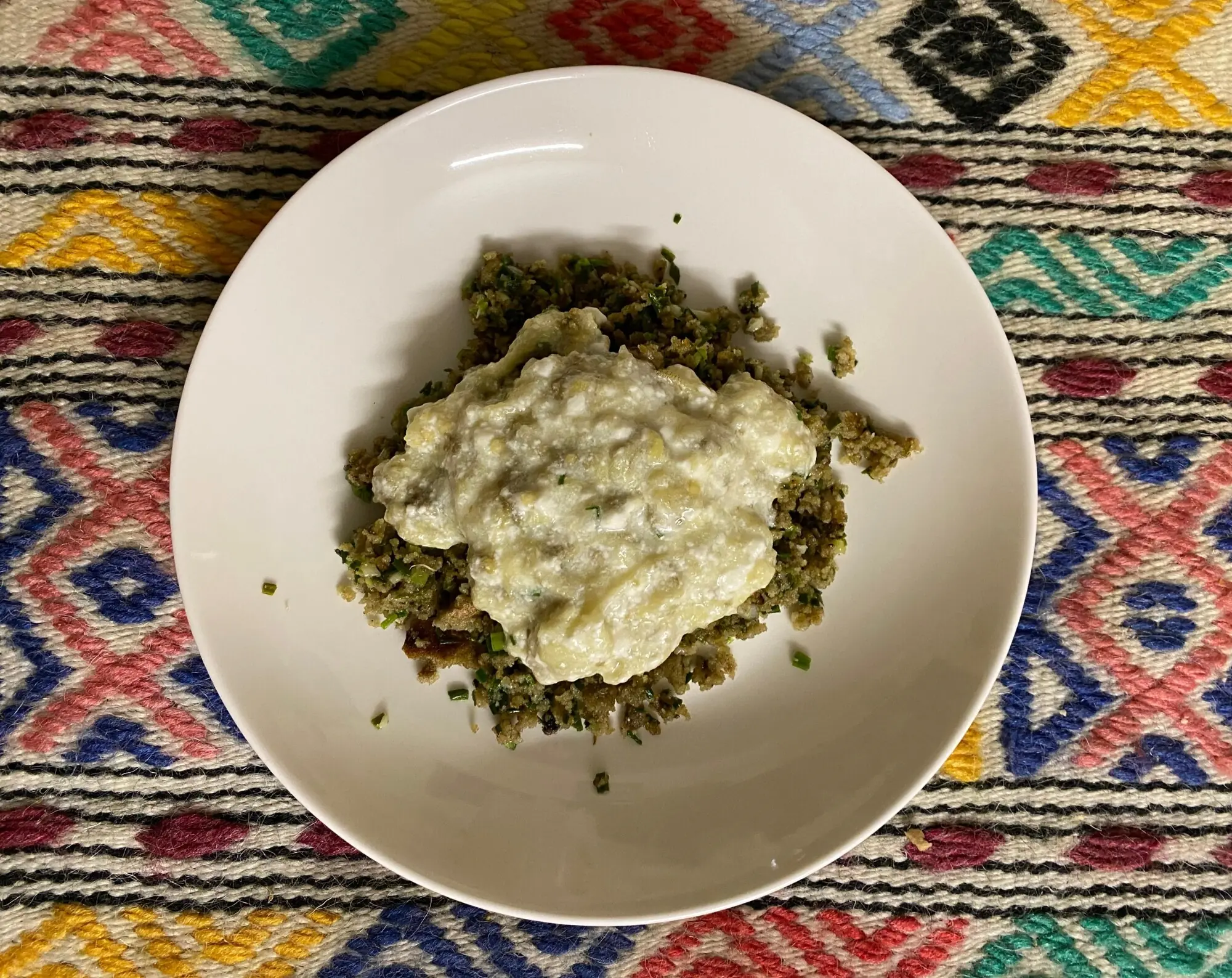
And once winter leaves, so does the brown, green, smoky and messy earthy goodness — until next year, when the cycle begins again.
Side note: The hara lasun seen in the pictures above was ordered by my mother from a home chef (@memoni_kitchen.123) because, as this piece has already established, winter without hara lasun is simply not winter. However, this year, my mother and nano, both severely afflicted by peak December-itis, were in absolutely no mood to pull an all-nighter chopping lasun and flipping rotis. Hence, they made a collective decision to outsource the labour, and preserve everyone’s sleep schedule and sanity, while keeping the tradition alive.