





‘Cloud-9’ a newly discovered celestial object can help solve a cosmic mystery
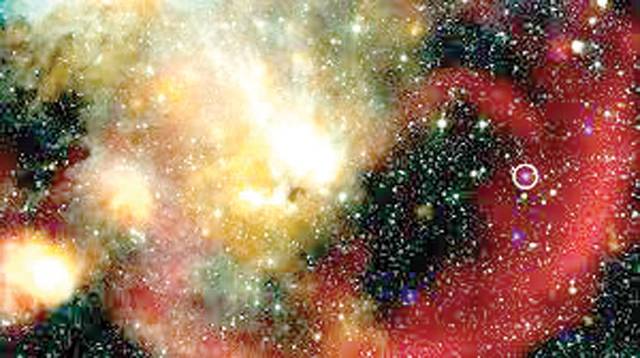
HOUSTON – Astronomers may have discovered a previously unknown type of astronomical object, nicknamed “Cloud-9,” that could shed light on dark matter, one of the biggest mysteries in the universe. Dark matter is an enigmatic substance that shapes the cosmos and provides it with structure. While it has never been directly observed, dark matter is believed to make up 85% of the total matter in the universe and can be detected due to its gravitational effects. Cloud-9 is thought to be a dark matter cloud that could be a remnant of galaxy formation from the early days of the universe, according to new research published Monday in The Astrophysical Journal Letters. “This cloud is a window into the dark Universe,” study coauthor Andrew Fox, an astronomer at the Space Telescope Science Institute in Baltimore, said in a statement. “We know from theory that most of the mass in the Universe is expected to be dark matter, but it’s difficult to detect this dark material because it doesn’t emit light. Cloud-9 gives us a rare look at a dark-matter-dominated cloud,” added Fox, who is affiliated with the European Space Agency (ESA) and the Association of Universities for Research in Astronomy (AURA). It has been theorized that dark matter originated from the big bang that led to the creation of the universe 13.8 billion years ago and makes up cosmic clouds that never accumulated enough gas to form stars. Recent observations made using the Hubble Space Telescope revealed Cloud-9 to be starless. “This is a tale of a failed galaxy,” said study coauthor Alejandro Benitez-Llambay, astrophysicist and assistant professor in the physics department at the University of Milano-Bicocca in Milan, Italy.
“In science, we usually learn more from the failures than from the successes. In this case, seeing no stars is what proves the theory right. It tells us that we have found in the local Universe a primordial building block of a galaxy that hasn’t formed.” Future observations of the cloud, and the discovery of more objects like Cloud-9, could lead to a greater understanding of dark matter, galaxy formation and evolution, and the early days of the universe. Unlike bright stars or star-filled galaxies, failed galaxies are dark, which makes them difficult to find. At first glance, Cloud-9 might have been mistaken for a faint dwarf galaxy, or a small galaxy composed of about 1,000 up to several billion stars, the research team said. Such galaxies are small when compared to our Milky Way, which contains hundreds of billions of stars.