

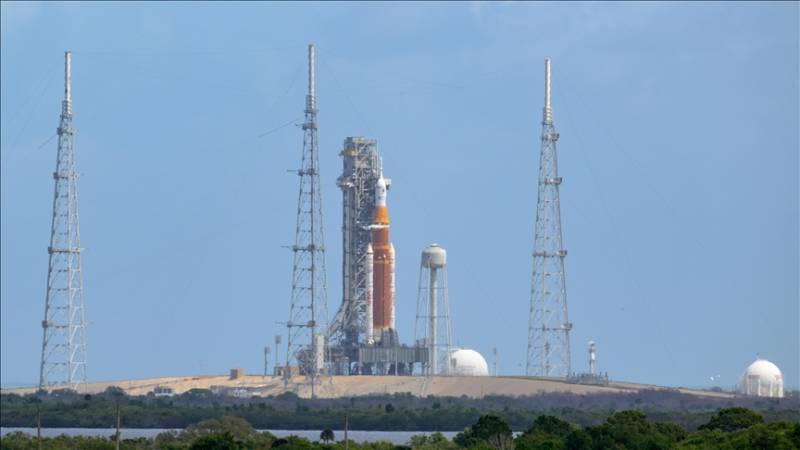


NASA launches Artemis II, marking astronauts’ 1st flight to moon since 1972
The US space agency NASA said Wednesday that its Artemis II mission successfully launched from the Kennedy Space Center in Florida, sending astronauts to the moon for the first time in more than 50 years.
The Space Launch System rocket carried four astronauts safely into orbit, with the Orion spacecraft now on course for a 10-day journey around the moon and back to Earth.
The crew includes three American astronauts and one Canadian on a mission aimed at testing critical systems needed for future human exploration of deep space.
The launch marks a major milestone in NASA’s Artemis program, which seeks to return humans to the moon later this decade and eventually support deeper space exploration.
‘It was quite something’
US President Donald Trump congratulated NASA and the astronauts of the Artemis II mission following its successful launch.
“Let me begin by congratulating the team at NASA and our brave astronauts on the successful launch of Artemis II. It was quite something,” he said during an address to the nation on Operation Epic Fury against Iran.
The president highlighted the scope of the mission, noting that the spacecraft will travel further than any crewed rocket in history.
“It will be traveling further than any manned rocket has ever flown and will very substantially pass the moon, go around it and come back home from a distance that has never been done before. It’s amazing,” he said.
Within hours of the mission’s launch, however, the crew reported a malfunction in what may have been the most anticipated new convenience of the Orion spacecraft: the onboard toilet.
Artemis 2 mission specialist Christina Koch noted a problem when starting up part of the Orion capsule’s toilet—known as the Universal Waste Management System—which handles urine collection.
“The toilet fan is reported to be jammed,” a NASA spokesperson Gary Jordan said during live mission commentary.
“Now the ground teams are coming up with instructions on how to get into the fan and clear that area to revive the toilet for the mission,” he added.
Norm Knight, NASA’s director of flight operations, told reporters at the Kennedy Space Center that the malfunction was caused by a controller issue in the toilet.
NASA confirmed that the astronauts could still use the space commode for bowel movements but not for urination while engineers worked to restore it to full functionality.
In the meantime, they’re getting their contingency — their backup waste management capabilities specifically for urine,” Jordan said.
“The fecal collection of the toilet, that specific capability, can still be used with the waste management system aboard Orion,” he added.