





Unanimous vote in risk assessment clears way for 4 astronauts to launch on moon mission
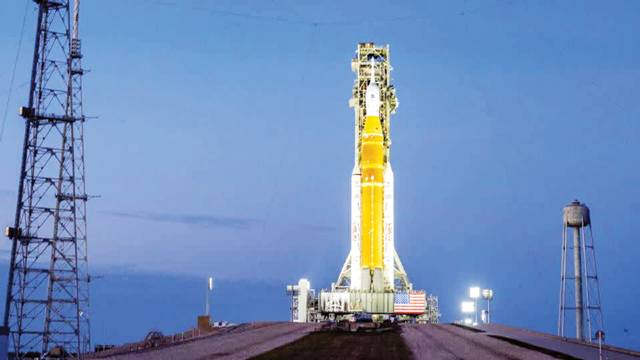
HOUSTON – NASA has finished a crucial risk assessment ahead of its upcoming lunar flyby mission, and during a news conference Thursday, the agency revealed a new target launch date and discussed how officials evaluated the dangers the mission’s four-person crew will face. The agency is now aiming to launch the historic mission, called Artemis II, on April 1 as soon as 6:24 p.m. ET. In the event of a delay, there are six additional windows for lift off next month on April 2, 3, 4, 5, 6 and 30.
The assessment — known as a Flight Readiness Review, or FRR — took place over two days this week and is a crucial step toward liftoff in which mission managers convene to determine whether the rocket, spacecraft and ground systems are ready for launch.
However, John Honeycutt, the chair of the Artemis II Mission Management Team, did not share a specific, quantitative risk estimate for this rocket and spacecraft. Figures that characterize the probability of “Loss of Mission” or “Loss of Crew” are two pieces of data the agency shared with the public in the Space Shuttle era, and similar analyses have been offered for many missions since. Before an uncrewed test flight called Artemis I in 2022, NASA assessed there was a 1 in 125 chance that the Orion spacecraft — the same type of vehicle that will carry the Artemis II crew — would be lost. “I know we have pursued Loss of Mission, Loss of Crew-type number assessments, but I’m not sure we understand what they mean in reality,” Honeycutt said, explaining such figures typically involve guesswork. Honeycutt noted that, because Artemis II will mark only the second-ever flight of NASA’s Space Launch System (SLS) rocket, there isn’t much data to go on in calculating such a figure for this flight.
“We’re probably not 1 in 50 on the mission going exactly like we want to, but we’re probably not 1 in 2 like we were on the first flight,” Honeycutt said of the SLS rocket, which boosts the Orion capsule to orbit. “I think we’re being really careful not to really lay probabilistic numbers on the table for this mission.” “I wouldn’t actually put a number on it,” added Lori Glaze, NASA’s acting associate administrator of the Exploration Systems Development Mission Directorate. An “incredible amount of work has gone into preparing for this test flight by thousands of people across our integrated team,” Glaze added.
“We had extremely thorough discussions — very open, transparent,” she said. “We talked a lot about our risk posture and how we’re mitigating those risks.” Glaze noted that the four Artemis II crewmembers — NASA’s Reid Wiseman, Victor Glover and Christina Koch and Canadian Space Agency astronaut Jeremy Hansen — joined the FRR virtually from their home base in Houston, Texas. “Having them join us in this review really reinforced the importance of having open, honest discussions,” Glaze added. Glaze said the astronauts tuned in for insight into how mission managers assessed the heat shield on the Orion spacecraft. The heat shield is a crucial piece of hardware designed to protect the crew as their capsule reenters Earth’s atmosphere upon returning from their 10-day, slingshot trip around the moon.