





NASA spacecraft makes an uncontrolled plunge back to Earth
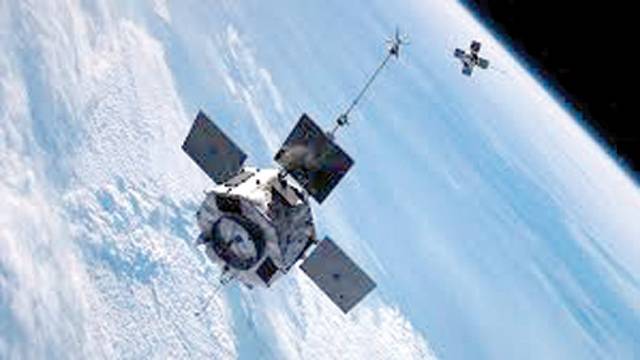
HOUSTON – A large space probe plummeted into Earth’s atmosphere early Wednesday — years earlier than expected. And while most of the spacecraft was expected to disintegrate in a flaming blaze during reentry, a few components could have survived, according to NASA. The odds that a piece of debris would cause harm to a person were estimated to be about about 1 in 4,200, the space agency said in a news release. That’s a low chance, according to NASA, and more favorable odds than those of space debris incidents of years past. “We’ve had things that have reentered have a 1 in 1,000 chance, and nothing happened; if we have a few that are 1 in 4,000 or 5000, it’s not a horrible day for mankind,” said Dr. Darren McKnight, a senior technical fellow at space-tracking company LeoLabs. But this risk was decidedly higher than some other notable events — including the 2018 reentry of China’s space station that put parts of the world on edge. The chance of debris hitting a human in that scenario was estimated to be less than 1 in a trillion, and no one was ultimately harmed. The 1,323-pound (600-kilogram) spacecraft that just reentered Earth was the now-defunct Van Allen Probe A, which NASA launched alongside a twin vehicle in 2012 to study the Van Allen radiation belts, two cosmic bands of high-energy particles that are trapped in Earth’s magnetic field at altitudes ranging from about 400 to 93,300 miles (640 to 58,000 kilometers). The probe plunged out of orbit and into Earth’s atmosphere at 6:37 a.m. ET Wednesday near the equatorial Pacific, south of Mexico and west of Equador, according to astrophysicist Jonathan McDowell, citing US Space Force data, and NASA. It was not immediately clear whether any part of the spacecraft survived the reentry process. No eyewitness encounters or injuries were reported right away. The radiation belts “shield Earth from cosmic radiation, solar storms, and the constantly streaming solar wind that are harmful to humans and can damage technology, so understanding them is important,” NASA said in a Tuesday statement. The Van Allen probes’ mission “made several major discoveries about how the radiation belts operate during its lifetime, including the first data showing the existence of a transient third radiation belt, which can form during times of intense solar activity.” The Van Allen Probe A — along with its twin, the Van Allen Probe B — studied the radiation belts for years longer than expected before concluding their mission in 2019 when the vehicles ran out of fuel. From the outset, NASA intended to dispose of the radiation-studying spacecraft by allowing them to burn up in the atmosphere as they plummeted to Earth. It was understood that a fiery cauldron of physics would likely reduce the probes to trace fragments by the time they reach the ground. Mission planners mapped out the probes’ return home when the spacecraft concluded its mission — conducting a few maneuvers designed to expel any remnants of fuel and confirm that the vehicles were in a position for atmospheric drag to slowly pull them out of orbit. Disposing of defunct spacecraft ensures they aren’t left to spend eternity flying uncontrolled through Earth orbit, where they could run the risk of colliding with active satellites or habitats such as the Internaitonal Space Station. Initially, NASA predicted the spacecraft would return home in 2034. “However, those calculations were made before the current solar cycle, which has proven far more active than expected. In 2024, scientists confirmed the Sun had reached its solar maximum, triggering intense space weather events,” NASA said in a Tuesday statement. “These conditions increased atmospheric drag on the spacecraft beyond initial estimates, resulting in an earlier-than-expected re-entry.”
The Van Allen Probe B is also now on track to be dragged out of orbit before 2030.